· ReadyStack
Worked example
Real numbers from this tool, line by line.
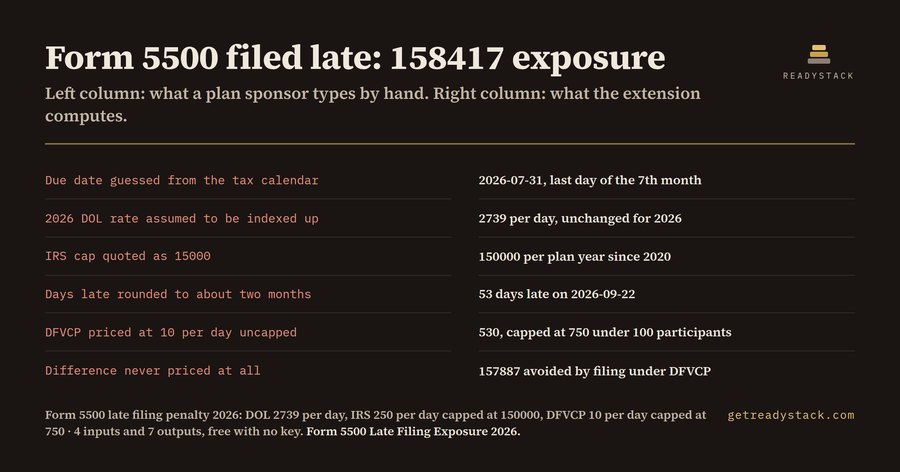
A calendar 2025 Form 5500 filed on 2026-09-22 is 53 days late and carries 158417 of statutory exposure, and the plan sponsor who files it under the DFVCP instead pays 530. That is the arithmetic a US 401(k) sponsor or third-party administrator is doing this month, usually wrong, usually with a chatbot.
The deadline is the easy part: the annual report is due on the last day of the seventh month after the plan year end, so a plan year ending 2025-12-31 was due 2026-07-31, and a Form 5558 filed on time pushes that to 2026-10-15. What people get wrong is what happens after the date passes.
Two agencies charge for the same late filing. The Department of Labor, under ERISA section 502(c)(2), can assess up to 2739 per day, with no ceiling at all. The IRS, under section 6652(e), charges 250 per day capped at 150000 per plan year. Run both meters for 53 days and you get 145167 from the DOL and 13250 from the IRS: 158417 in total.
Here is the part that is wrong in almost every answer a generative model gives this year. Federal civil monetary penalties are normally indexed for inflation each January, so the sensible assumption is that the ERISA daily maximum rose for 2026. It did not. The October 2025 price data that drives the adjustment was never published and the 2026 civil penalty inflation adjustments were cancelled, so the 2025 figure of 2739 per day carries straight into 2026. A model that helpfully indexes the number is inventing a rate. So is a model that quotes 25 per day and a 15000 cap on the IRS side: those were the pre-SECURE Act figures, replaced for plan years beginning after 2019 by 250 per day and 150000.
Against those numbers sits the Delinquent Filer Voluntary Compliance Program. DFVCP charges 10 per day, capped at 750 per plan year for a plan with fewer than 100 participants at the start of the year and 2000 for a larger plan. The 53 day filing costs 530 under the program, and the difference between the two paths is 157887. The catch is timing: the program is open only until the DOL issues a notice of failure to file, which is why the number is worth having on screen before anyone opens the mail.
The comparison sharpens the longer a plan year sits. A plan year ending 2024-06-30, due 2025-01-31 and still unfiled on 2026-09-22, is 599 days late: the IRS side stops at its cap of 149750, the DOL side does not stop and reaches 1640661, for 1790411 in total. The DFVCP amount for that plan, with 250 participants, is 2000, so the difference is 1788411.
That is the whole tool. Four inputs, seven outputs, in the popup of a Chrome, Edge or Firefox extension and on a free web page built from the same code, with nothing about the plan leaving the browser.
All of that is free: no key, no watermark, no lock after a number of runs, no blocked answer. The paid layer sits on a different axis rather than a bigger number. A 29 licence key exports the worked figures as a CSV row for the plan file or for counsel, and sets browser alarms for the next Form 5500 due date and the Form 5558 extended date across every plan you administer.
For comparison, an ERISA counsel or TPA delinquency review is quoted at 350 an hour and usually runs two to three hours per plan year, most of it spent on the day count and the rate lookup. Those hours are better spent on the DFVCP application itself, with a paper Form 5500 attached for each delinquent plan year. One practical note on the count: penalties accrue from the day after the return was due, and the DOL day count does not pause because the IRS cap has been reached.
Questions people ask
What does this extension actually do?
It turns a plan year end and a filing date into what a late Form 5500 really costs. From 4 inputs it returns 7 outputs: the statutory due date, the days late, the DOL exposure at 2739 per day, the IRS penalty at 250 per day capped at 150000, the total, the DFVCP amount at 10 per day, and the difference.
Who is it for?
US 401(k) and 403(b) plan sponsors, HR and finance managers who own the annual report, and third-party administrators cleaning up a delinquent filer. If you are the person who has to explain a missed 2026-07-31 deadline to an owner or an auditor, the 7 outputs on screen are the ones you need.
Why not just ask a chatbot or read the instructions?
Generative models still quote the pre-SECURE Act cap of 15000 and assume the ERISA daily maximum was indexed upward for 2026. It was not: the 2026 federal civil penalty inflation adjustment was cancelled, so 2739 per day carries over. A wrong daily rate multiplied by 53 days is a five figure error.
What is free and what needs the key?
Every calculation is free and unlimited, in the popup and on the web page, with no watermark and no lock after a number of runs. The 29 licence key adds two things on a different axis: CSV export of the worked figures for the plan file, and alarms for the next Form 5500 and Form 5558 dates.
What would this cost me otherwise?
An ERISA counsel or TPA delinquency review is quoted at 350 an hour and usually runs 2 to 3 hours for a single plan year, before the filing itself. The extension does the arithmetic part in seconds so the billed hours go to the DFVCP application rather than to counting days.
Ask about this tool
One question, answered by the person who built it. Your email only if you want the answer sent.